Schools going herbal in and outside of Kathmandu
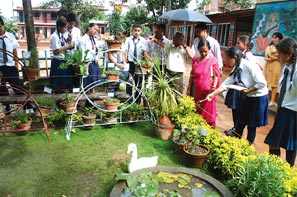
Kathmandu: On World Environment Day, June 5 2010, International Center for Integrated Mountain Development (ICIMOD) and the National Trust for Nature Conservation (NTNC), in collaboration with the Private and Boarding Schools’ Organization of Nepal (PABSON) launched a competition for 15 schools within Kathmandu.
Unlike schools competing to win the championship in sports or the arts, the participants spent months tending to their own herbal garden in their schools.
Over a year later, the project is not just on-going, it is expanding as seven schools have decided to pass on the Herbal Garden in Schools initiative to other schools.
According to ICIMOD, “The Promoting Herbal Gardens in Schools has been a fun-filled learning activity for the children where they got the opportunity to learn about the medicinal plants by actually planting the medicinal herbs and watching them grow in their garden, and by exploring information about them from various sources. The task of making the garden itself has been enriching in terms of making children realize the importance of team work such as detailed planning, and allocation of tasks within a team.”
But beyond just benefiting the students, the teachers too have been able to gain from the gardens, as ICIMOD reports, “For the teachers, herbal garden project has been useful in terms of the ease with which they could integrate the concept with other activities, such as writing essays, poems and stories, making posters, drawing and painting, making herbariums, and even preparing food recipe using some of the culinary herbs students have planted in their gardens.”
Originating with the idea of promoting medicinal herbs of the Himalayan Mountains, the project’s goal was to educate the younger population of the uses of plants in the region. And there is good reason to promote these herbs as “these plants have been grown or collected for thousands of years, and the traditional knowledge about the plants and their uses have been come down by word of mouth from generation to generation.”
However, due to a multitude of reasons ranging from overharvesting, loss of habitat, increasing urbanization and shrinking forest resource base, the knowledge and tradition that comes with these herbs are at a risk of being lost.
Thankfully, according to Achala Thapa, principal of Vajra Academy, “The program on promoting Herbal Gardens in Schools has innovatively involved students in creating awareness about herbal plant resources, which as a matter of fact has been ignored in the existing education system.”
Vajra Academy won the title of ‘Best Herbal Garden’ for transforming a barren slope into an herbal garden.
The school engaged all their students and encouraged them to learn the name of the plants by giving their scientific names.
The other winners are Suryodaya Jyoti Secondary School and Ullens School tied for 1st Runners up, Loyalty Academy and Annal Jyoti Boarding School were 2nd Runners Up, and Rato Bangala and Aims Academy received a special mention.
Now in 2011, six schools, Aims Academy, Annal Jyoti Boarding School, Rato Bangala, Suryodaya Jyoti Secondary School, Ullens School, and Vajra Academy along with the NGO Environmental Camps for Conservation Awareness (ECCA) are replicating the program in various schools in and outside of the Valley.
As for promoting the project Achala Thapa adds, “My students, from all the grades have not only sown the plants in the garden, but have internalized them in their hearts. With enthusiasm, we are ready to replicate the concept and transfer the experience and knowledge to other schools in the community.”
Milan Dixit, Principal, Rato Bangala School too is excited about sharing the initiative and says, “Rato Bangala has an education outreach program in Dailekh, where we are working with 480 public schools. We are more than eager to take the concept there and spread awareness about herbal plants and their importance.”
Each of the seven participants will mentor three public schools with at least one school from outside of the Valley.
Nira Gurung, Communications Officer, Knowledge Management, at ICIMOD explains, “The schools will continue with the initiative with monitoring by ECCA. We hope that the concept will be taken up by more schools, and the communities. ECCA has a developed a strategy for this furthering and to ensure its sustainability in the long run.”
source: Thapa,Shreya (2011),"Schools going herbal in and outside of Kathmandu",republica, 21 Dec 2011


Posted on: 2011-12-21
Misc. News

Nabil SSE Fellowship Program 2026
Nabil School of Social Entrepreneurship - Nabil SSE, in collaboration with the School…
Nepal Nursing Council-NNC Licensing Examination result 2083
The Nepal Nursing Council (NNC) is an autonomous body formed to maintain quality…
Nepal Medical Council Special Examination Result : How to Check Result ?
The Nepal Medical Council has published the results of the special examination conducted…
Chevening UK Scholarships in Nepal 2027-2028
Applications for 2027-2028 Chevening Scholarships are now openChevening is the UK…
Nepal Medical Council 76th Licensing Examination (NMCLE) Notice
The Nepal Medical Council (NMC) is a statutory body regulating medical education…
Nepal Bar Council Advocate Level Examination Online Application Notice 2083 (2026)
Nepal Bar Council is an independent legal institution established by the Nepal Bar…Featured News

TSC - Shikshak Sewa Aayog Vacancy Calendar 2083/2084 (2026-2027)
The Teachers Service Commission (TSC - Shikshak Sewa Aayog) was established to recommend…
TU Bachelor Level 2nd Year Exam Center Notice published
Tribhuvan University, Office of the Controller of Examination, Balkhu has published…
Tribhuvan University 52nd Convocation Ceremony 2083 (2026)
Tribhuvan University 52nd Convocation Form Filling Notice : 17 September 2026Tribhuvan…
TU MBS Model & Old Exam Question Paper, Solutions and Syllabus
The objective of the Tribhuvan University Master of Business Studies (MBS) programme…
TU Exam Routine, Exam Centers, Exam Form Fill up Notice 2083 2026
Tribhuvan University Exam Routine, Exam Centers, Exam Form Fill up notice updates:4…
TU Bachelor 2nd year Exam routine
Tribhuvan University, Office of the Controller of Examination, Balkhu has the published…Featured Articles

Lok Sewa Aayog (PSC) Exams Reading Materials 2083 (2026-2027)
Lok Sewa Reading Materials from the year 2083 B.S. (2026-2027 AD ) that were printed…
Lok Sewa Old Past Exam Questions for Assistant and Officer Level
Collection of Lok Sewa Old / Past question for various Assistant and Officer level…
Nepal Telecom-NTC Lok Sewa Old Exam Question and Answer
Only by practicing authentic Nepal Telecom question papers will you gain a true…
ADBL Exam Preparation: Old Question, Practice Question, Syllabus
This article contains old questions and answers, practice questions, and a syllabus…
Lok Sewa Annual Vacancy Calendar 2083 2084 ( All Provinces)
Individuals can use the Lok Sewa Annual Vacancy Calendar to participate in various…
Lok Sewa - Bank Vacancy Calendar FY 2083-2084 (2026/2027) in Nepal
The calendar also includes job openings at Nepal Rastra Bank, the country's…Featured vacancies


Jobs at PHASE Nepal; Salary: NPR 55,000+ per month
Deadline: 2026-01-10
Vacancy notice from NIMB Ace Capital Ltd.
Deadline: 2026-10-09
Province Lok Sewa Aayog, Gandaki Province announces vacancy
Deadline: 2026-10-27
Vacancy notice from Everest Bank Limited
Deadline: 2026-10-13