Robotics for humanitarianism
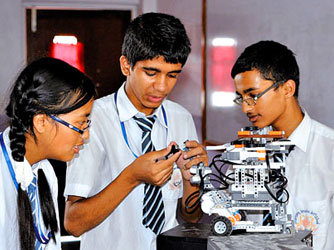
The engineering department of Trinity College in Connecticut, USA has been working on a robotics program with a humanitarian focus. As part of the program, students build and program robots that can be applied in humanitarian fields like helping the disabled and the elderly.
In 2010, two Nepali students, Binay Poudel and Sarthak Khanal from Trinity College were awarded the prestigious Davis Award for Peace.They used the fund to conduct a robotics workshop in Haifa, Israel in coordination with Madatech, Israeli National Museum of Science and Technology.
The program aimed at providing an environment for Hebrew speaking and Arab speaking students to work together as a team and understand each other’s culture.
As continuation and part of the same project, a six week long robotics workshop was organized at Learning Realm International (LRI) School in Kalanki with the aim of developing a household assistance Robot, for the physically challenged and the elderly.
The final competition and closing ceremony of the program with the theme, ‘Robotics For Peace, 2011’ event was held at the LRI School premises on August 27.
Tashi Genden, one of the co organizers of the program and a volunteer, also a student at Trinity College, had come along with his friends to assist in this project.
He informed that this particular workshop was funded by the Engineering Department of Trinity College in Connecticut, USA, which is headed by Professor David Ahlgren. The Connecticut Council of Developmental Disabilities was an important advisor of the event.
“For the workshop, we chose twenty students from the school itself and divided them into five teams. We taught them to assemble robotic kits at the LRI physics lab itself,” said Genden.
He further added that he along with four of his friends, all of them whom are engineering students taught students about programming the robots.
This is the first humanitarian robotics project of this kind in Nepal. “The fact that the participants of this program are grade nine and ten students make this program an opportunity for young students to experience a unique blend of technology and social service,” added Genden.
At the beginning of the program ‘Robowaiter’ competition was held. The numbers of participants at the program were twenty and the numbers of competing teams were five and each team got five trials.
Each team had to place their robot in a simulated kitchen area. It was of 8.5ft by 8.5 ft arena. The robot then grabbed a plate from a table and delivered it next to a doll representing a disabled person and then returned to its starting position. The robots had to do that without any external control.
The teams were evaluated based on the number of tasks completed by their robots and the total time taken.
After the competition, a prize distribution ceremony was held. The winners of the competition were the team of Priya Shree KC, Kiran Pun, Anshu Singh and Ranjan Khanal of grade nine and ten.
source:republica(2011),"Robotics for humanitarianism ", republica, 28 August 2011


Posted on: 2011-08-30
Misc. News

Nabil SSE Fellowship Program 2026
Nabil School of Social Entrepreneurship - Nabil SSE, in collaboration with the School…
Nepal Nursing Council-NNC Licensing Examination result 2083
The Nepal Nursing Council (NNC) is an autonomous body formed to maintain quality…
Nepal Medical Council Special Examination Result : How to Check Result ?
The Nepal Medical Council has published the results of the special examination conducted…
Chevening UK Scholarships in Nepal 2027-2028
Applications for 2027-2028 Chevening Scholarships are now openChevening is the UK…
Nepal Medical Council 76th Licensing Examination (NMCLE) Notice
The Nepal Medical Council (NMC) is a statutory body regulating medical education…
Nepal Bar Council Advocate Level Examination Online Application Notice 2083 (2026)
Nepal Bar Council is an independent legal institution established by the Nepal Bar…Featured News

TSC - Shikshak Sewa Aayog Vacancy Calendar 2083/2084 (2026-2027)
The Teachers Service Commission (TSC - Shikshak Sewa Aayog) was established to recommend…
TU Bachelor Level 2nd Year Exam Center Notice published
Tribhuvan University, Office of the Controller of Examination, Balkhu has published…
Tribhuvan University 52nd Convocation Ceremony 2083 (2026)
Tribhuvan University 52nd Convocation Form Filling Notice : 17 September 2026Tribhuvan…
TU MBS Model & Old Exam Question Paper, Solutions and Syllabus
The objective of the Tribhuvan University Master of Business Studies (MBS) programme…
TU Exam Routine, Exam Centers, Exam Form Fill up Notice 2083 2026
Tribhuvan University Exam Routine, Exam Centers, Exam Form Fill up notice updates:4…
TU Bachelor 2nd year Exam routine
Tribhuvan University, Office of the Controller of Examination, Balkhu has the published…Featured Articles

Lok Sewa Aayog (PSC) Exams Reading Materials 2083 (2026-2027)
Lok Sewa Reading Materials from the year 2083 B.S. (2026-2027 AD ) that were printed…
Lok Sewa Old Past Exam Questions for Assistant and Officer Level
Collection of Lok Sewa Old / Past question for various Assistant and Officer level…
Nepal Telecom-NTC Lok Sewa Old Exam Question and Answer
Only by practicing authentic Nepal Telecom question papers will you gain a true…
ADBL Exam Preparation: Old Question, Practice Question, Syllabus
This article contains old questions and answers, practice questions, and a syllabus…
Lok Sewa Annual Vacancy Calendar 2083 2084 ( All Provinces)
Individuals can use the Lok Sewa Annual Vacancy Calendar to participate in various…
Lok Sewa - Bank Vacancy Calendar FY 2083-2084 (2026/2027) in Nepal
The calendar also includes job openings at Nepal Rastra Bank, the country's…Featured vacancies


Jobs at PHASE Nepal; Salary: NPR 55,000+ per month
Deadline: 2026-01-10
Vacancy notice from NIMB Ace Capital Ltd.
Deadline: 2026-10-09
Province Lok Sewa Aayog, Gandaki Province announces vacancy
Deadline: 2026-10-27
Vacancy notice from Everest Bank Limited
Deadline: 2026-10-13